Most people know their credit card charges interest. Far fewer know how it charges interest — and the how is exactly why a balance can feel frozen in place even when you’re paying every month.
This is the foundation piece. Once you understand the five mechanics below — the APR, the daily periodic rate, the grace period, the average-daily-balance method, and the payment order — every other debt topic on this site gets easier. Minimum payments make more sense. Balance transfer offers make more sense. Let’s build the picture from the ground up.
1. APR is a yearly number; you pay it daily
APR stands for Annual Percentage Rate — the yearly cost of borrowing, expressed as a percentage. As of Q2 2026, the Federal Reserve’s G.19 release reported the average APR at 20.94% across all credit card accounts, and 22.15% on accounts that actually accrue interest (that is, accounts carrying a balance month to month). If you carry a balance, the 22.15% figure is the relevant one.
Here’s what trips people up: the APR is annual, but interest is charged daily. Your issuer converts the APR into a daily periodic rate by dividing by 365:
22.15% ÷ 365 ≈ 0.0607% per day
That looks tiny. It isn’t. Every day, your balance grows by roughly six-hundredths of one percent. On a $5,000 balance, that’s about $3.03 per day — roughly $91 a month — before you pay a cent toward the principal.
The daily rate matters because it means interest is compounding: each day’s interest is calculated on a balance that already includes yesterday’s interest. Over a year, daily compounding at a nominal 22.15% APR produces an effective rate slightly above 22.15% (about 24.8%, if you’re curious about the math). The difference between nominal APR and the effective rate is small but real — and it’s one reason your balance can grow a touch faster than a simple “22% of the balance” estimate would suggest.
What the APR doesn’t include: fees. Annual fees, late fees, balance transfer fees, and cash advance fees sit outside the APR. When you compare the cost of carrying a balance versus alternatives, factor those in separately.
2. The grace period: interest-free borrowing, with a catch
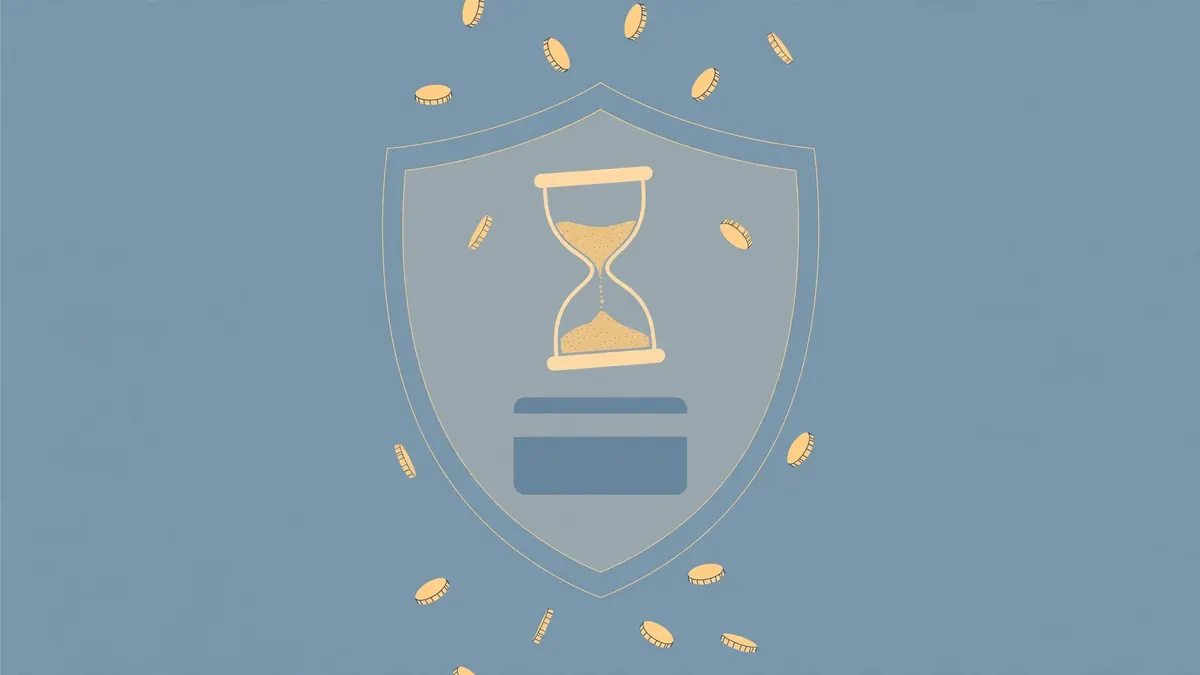
Most credit cards offer a grace period — typically 21 to 25 days between the end of your billing cycle and your payment due date. If you pay your full statement balance by the due date, you pay zero interest on purchases. This is how people use credit cards for free: buy, pay in full, repeat.
The catch is absolute: the grace period only applies if you pay the full balance. The moment you carry even $1 of a balance past the due date, the grace period vanishes — and on most cards, it vanishes for new purchases too. From that point, interest starts accruing on new purchases from the day they’re posted, with no grace period at all. This continues until you pay the full balance again — sometimes for two consecutive billing cycles, depending on the card’s terms.
This is why “I’ll just put this one purchase on the card while I’m paying it down” is so costly. Without a grace period, that purchase starts generating interest immediately, at your full purchase APR, on top of everything else.
3. The average-daily-balance method: how the interest is actually calculated
Your issuer doesn’t just apply the daily rate to your ending balance. Most use the average daily balance method. Here’s how it works:
- Each day of the billing cycle, the issuer records your balance at the end of the day (including new purchases, minus payments and credits).
- At the end of the cycle, it averages all those daily balances.
- It multiplies the average by the daily periodic rate, then by the number of days in the cycle.
A simplified example — assume a 30-day cycle, a daily periodic rate of 0.0607%, and no grace period:
- Days 1–10: balance $5,000 → contributes $50,000 to the sum
- Day 11: you pay $500 → balance $4,500
- Days 11–30: balance $4,500 → contributes $90,000
- Sum of daily balances: $140,000
- Average daily balance: $140,000 ÷ 30 ≈ $4,667
- Interest: $4,667 × 0.000607 × 30 ≈ $85
Notice the timing lesson: the $500 payment on day 11 only reduced the average balance for 20 of the 30 days. A payment made on day 2 would have cut the average balance far more. When you pay within the cycle matters — earlier payments reduce the average daily balance more than later ones. If your issuer allows multiple payments per cycle, paying right after payday rather than waiting for the due date trims the interest slightly.
A few cards use the daily balance method instead (interest computed each day on that day’s balance and summed). The practical difference is minor; the timing lesson is the same either way.
4. Your payment hits interest first
When you make a payment, the issuer doesn’t split it proportionally across principal and interest. By law and by standard practice, your payment is applied in this order:
- Interest and fees first. Every dollar of accrued interest and fees is satisfied before principal is touched.
- Then principal, applied to the highest-APR balances first (for amounts above the minimum).
This is the mechanical reason balances “barely move.” Revisit the month-one example from the minimum-payment walkthrough: on a $5,000 balance at 22.15%, one month’s interest is about $92. A $145 minimum payment covers the $92 of interest first, leaving only ~$53 for principal. The payment isn’t small relative to nothing — it’s small relative to the interest the balance generates each month.
The CARD Act of 2009 added one consumer protection here: any amount you pay above the minimum must go to the highest-APR balance first. So extra payments are efficient by law. Minimum payments, however, can be applied to the lowest-rate balances first — another quiet reason minimums retire debt so slowly.
5. Penalty APRs and variable rates: the rate can change
Two more things can move your rate after the account is open:
- Variable APRs. Most cards have variable rates tied to the prime rate — the benchmark the CFPB describes as what most banks use to set card APRs. When the Federal Reserve moves its target rate, prime moves, and card APRs typically follow within a billing cycle or two. Your 22.15% is not locked; it’s a snapshot.
- Penalty APRs. If you pay more than 60 days late, the issuer can apply a penalty APR — often near 30% — to your existing balance. The CARD Act requires the issuer to restore your original rate after six consecutive on-time payments, but the months at the penalty rate are expensive.
Both are disclosed in your cardholder agreement, which almost nobody reads. The key terms — your current APR, whether it’s variable, and the penalty APR — are also summarized in the Schumer box on your statement. Worth a glance.
Cash advances: the expensive corner of your card
One more mechanic deserves its own warning: cash advances — withdrawing cash against your credit line at an ATM or via a convenience check — play by harsher rules than purchases:
- Higher APR. The cash advance APR is typically several points above your purchase APR.
- Upfront fee. Usually 3% to 5% of the advance amount (with a dollar minimum), charged immediately.
- No grace period, ever. Interest starts accruing the day the advance posts, even if you normally pay your balance in full.
- No rewards, no protection. Cash advances don’t earn rewards and don’t get purchase protections.
A $500 cash advance at a 29% APR with a 5% fee costs you $25 the moment you take it, then accrues interest daily from day one. Among card features, it’s the closest thing to a pure cost with no upside. If you’re considering one to cover a payment on another debt, that’s a strong signal to look at structured options instead — the math only deepens the hole.
Find these numbers on your own statement
Everything in this article is personalized on the statement you already receive. Here’s where to look:
- Your purchase APR appears in the interest-charge summary or “account summary” section, often labeled “APR for purchases.” Check whether it’s marked variable.
- The daily periodic rate is sometimes printed alongside the APR. If not, divide your APR by 365.
- Interest charged this period is listed as a line item — compare it against your payment to see your own interest-to-principal split.
- The minimum-payment disclosure (required since the CARD Act of 2009) shows how long minimums alone would take and their total cost, next to a 36-month payoff comparison.
- Cash advance and penalty APRs are in the rate table, usually on the back page or in the cardholder agreement.
Reading these five numbers once turns the abstract mechanics above into your concrete situation — and it’s the fastest way to see which lever (earlier payments, fixed higher payments, restoring the grace period) helps you most.
Putting it together: why the balance barely moves
Now the full picture in one paragraph. Your balance grows every day at the daily periodic rate on the average daily balance — about $3 a day on a $5,000 balance at today’s average rate. If you carried a balance, your grace period is gone, so even new purchases accrue interest from day one. When you pay, interest and fees are satisfied first and only the remainder touches principal. And if your payment is the minimum — which shrinks as the balance shrinks — the interest share of each payment stays high for years. The balance barely moves because the system is working exactly as designed: interest first, principal with whatever is left.
Understanding this isn’t about feeling worse. It’s about seeing the levers:
- Pay earlier in the cycle to cut the average daily balance.
- Pay a fixed amount above the minimum so the principal share grows each month.
- Restore the grace period by paying the full balance — after that, new purchases stop accruing immediate interest.
- Don’t add new purchases while carrying a balance, since they accrue interest from day one with no grace period.
Each of these follows directly from the mechanics above — no tricks, no products, just the rules of the system applied in your favor.
DebtRelief.site publishes general educational information only — not financial, legal, or tax advice. Consider speaking with a qualified professional about your situation.