Paying the minimum keeps your account in good standing: no late fee, no missed-payment mark on your credit report. That's what the minimum is for. It is a floor, not a plan.
This article is not a lecture about minimums. It is arithmetic. Below is exactly what happens — month by month — when a typical balance meets a typical minimum payment at today's actual interest rates. No scare tactics; the numbers are dramatic enough on their own.
The scale of the problem
Minimum-only payers are not rare. In its 2025 Consumer Credit Card Market Report, the Consumer Financial Protection Bureau (CFPB) found that in 2024, 15% of general-purpose cardholders and 20% of private-label (store card) holders made only the minimum payment. The same report flagged "persistent debt" — accounts where a year's worth of interest and fees exceeded half of everything the cardholder paid — at 13% of general-purpose accounts, up from under 10% two years earlier.
The balances are large, too. TransUnion's Q2 2026 figures put the average credit card debt per borrower at $6,610, with about 176.9 million consumers carrying a balance. The New York Fed's Q2 2026 Household Debt and Credit Report counted $1.26 trillion in total credit card balances. A lot of minimum payments are being made on a lot of debt.
How the minimum is actually calculated
Minimum payments aren't random — they follow formulas your issuer discloses in the cardholder agreement. The CFPB's review of issuer practices found two common structures:
- Interest + a percentage of the balance: typically that month's interest charges plus 1% of the outstanding balance (the formula used in our example). The payment automatically shrinks as the balance shrinks.
- A flat percentage of the balance: commonly 1% to 3% of the total balance, sometimes including the finance charges in that percentage.
Nearly all issuers also set a floor — a minimum minimum, usually around $25 — so the payment never drops to a few dollars even when the balance is small. Credit unions tend to set lower floors; subprime-focused issuers tend to set higher ones.
Why does the formula matter? Because a percentage-of-balance minimum is designed to decline. In year one of our example, the minimum is ~$145. By year ten, with the balance much smaller, the minimum is a fraction of that. The formula guarantees the timeline stretches: just as compounding needs time to do its worst, the shrinking payment gives it that time.
Year by year: watching the balance crawl
To make the 18.5-year timeline tangible, here's a snapshot of the example balance at intervals (same assumptions: $5,000 start, 22.15% APR, minimum = interest + 1% of balance):
| After… | Approx. balance | Total interest paid so far |
|---|---|---|
| 1 year | ~$4,400 | ~$1,050 |
| 5 years | ~$2,650 | ~$4,120 |
| 10 years | ~$1,405 | ~$6,305 |
| 15 years | ~$720 | ~$7,460 |
| 18.5 years | $0 | ~$7,780 |
After a full year of never missing a payment, you still owe about $4,400 — and you've paid over $1,000 mostly to interest. After five years of perfect minimum payments, you've handed over roughly $4,120 in interest and still owe about $2,650. This is the shape of the trap: dutiful, on-time, minimum-only payments that feel responsible while the debt barely yields.
The math: $5,000 at 22.15% APR, minimums only
Let's walk through a concrete example. Assumptions are stated plainly — this is illustrative, not a prediction:
- Starting balance: $5,000
- APR: 22.15% — the average APR on credit card accounts that actually accrue interest, as of Q2 2026 (Federal Reserve G.19 release). This is the rate that applies to people carrying balances, which is exactly who this article is about.
- Minimum payment formula: that month's interest plus 1% of the balance, with a $25 floor. The CFPB has documented this as the standard structure large issuers use.
- No new purchases. Every new charge would reset the math and make it worse.
Month 1: Interest accrues first. At 22.15% APR, one month's interest on $5,000 is $5,000 × 0.2215 ÷ 12 ≈ $92.29. The minimum payment comes to roughly $145. Of that $145, $92.29 — about 64% — goes straight to interest. Only about $53 reduces what you actually owe. Month one ends with a balance of about $4,947.
That 64%-to-interest split is the whole story in miniature. When your rate is high and your payment is small, most of the payment feeds the interest and only a sliver attacks the principal. And because the minimum is tied to the balance, the payment shrinks as the balance shrinks — so in later years you're paying less, which stretches the timeline even further. Interest has more time to compound against a larger remaining balance. How credit card interest actually accrues explains the mechanics in detail.
The full timeline:
| Minimum payments only | |
|---|---|
| Months to pay off | 222 (18.5 years) |
| Total interest paid | ≈ $7,780 |
| Total paid | ≈ $12,780 |
Read that again: a $5,000 purchase, paid with minimums at today's average rate, costs roughly $12,780 over 18 and a half years. You pay about $7,780 in interest — more than 150% of the original balance — and you pay it for longer than a typical mortgage's first phase.
This is not because of some trick. It is the natural consequence of a payment designed to keep the account current, not to retire the debt. The issuer prices the minimum to cover its interest plus a token of principal. Your balance is profitable to carry, so the minimum is sized to let you carry it.
What a small fixed payment changes
Now change exactly one thing: instead of the shrinking minimum, pay a fixed $200 a month — just $55 more than that first minimum payment of $145.
| Minimum only | Fixed $200/month | |
|---|---|---|
| Months to pay off | 222 (18.5 years) | 34 (2.8 years) |
| Total interest | ≈ $7,780 | ≈ $1,770 |
| Total paid | ≈ $12,780 | ≈ $6,770 |
The difference: $6,010 less in interest, and debt-free about 15.7 years sooner. The magic isn't the extra $55 in month one — it's that the payment stays at $200 while the minimum would have kept shrinking. A fixed payment attacks a growing share of principal as the balance falls, which is the opposite of what minimums do.
If $200 is out of reach, the principle still holds at any level: any fixed amount above the minimum shortens the timeline. Even $160 a month beats the minimum-only path by years. The enemy isn't the size of your payment — it's the shrinking payment.
Why statements show you this math
Since the CARD Act of 2009, your credit card statement must include a minimum-payment disclosure: how many years it will take to pay off your current balance with minimums only, and how much total interest that costs — alongside what you'd pay on a 36-month payoff schedule. Congress required this because the minimum-only trap was so costly and so invisible.
Find that box on your next statement and read it. It is personalized to your balance and your rate — more accurate for you than any example in this article. If the number of years surprises you, that's the disclosure working as intended.
The psychology that keeps minimums going
None of this is to shame anyone paying minimums. People land on minimums for understandable reasons: tight months, job losses, medical bills, the sheer mental relief of seeing "minimum payment due" as a manageable number. The CFPB's persistent-debt data shows millions of households are in exactly this position — it's common, not a character flaw.
But it helps to see the minimum clearly for what it is: the amount that keeps the issuer whole while keeping you in debt the longest. Issuers profit from carried balances; the Federal Reserve Bank of Boston has found that minimum-only payers are among issuers' most profitable customers. That's not a conspiracy — it's just how the pricing works. Knowing it lets you decide how much of your money goes to interest versus principal with open eyes.
When minimums are the right call — temporarily
Everything above describes minimums as a long-term strategy. As a short-term tactic, minimums have a legitimate job: protecting your account during a rough patch. If you've lost income, faced a medical emergency, or are choosing between the minimum payment and rent, paying the minimum is the right move for that month. It avoids a late fee, avoids a missed-payment mark on your credit report, and keeps the account open.
The distinction is duration. Minimums as a bridge — a few months while you stabilize — cost relatively little. Minimums as a lifestyle cost $7,780 on a $5,000 balance. If you notice you've been paying minimums for six months or more without a plan to change that, treat it as the signal it is: not a failure, but information that the current approach needs a supplement, whether that's a budget reset or a conversation with a nonprofit credit counselor.
Practical next steps
If the math above got your attention, here are realistic moves, roughly in order of effort:
- Pay a fixed amount, not the minimum. Pick the highest fixed number you can sustain every month and automate it. This single change is the most powerful lever you have.
- Stop adding new charges to the card you're paying down. New purchases accrue interest immediately and dilute every payment you make.
- Know what you'd pay at a fixed pace. A payoff calculator can show your timeline and total interest at different monthly amounts — seeing the trade-off in dollars makes the choice concrete.
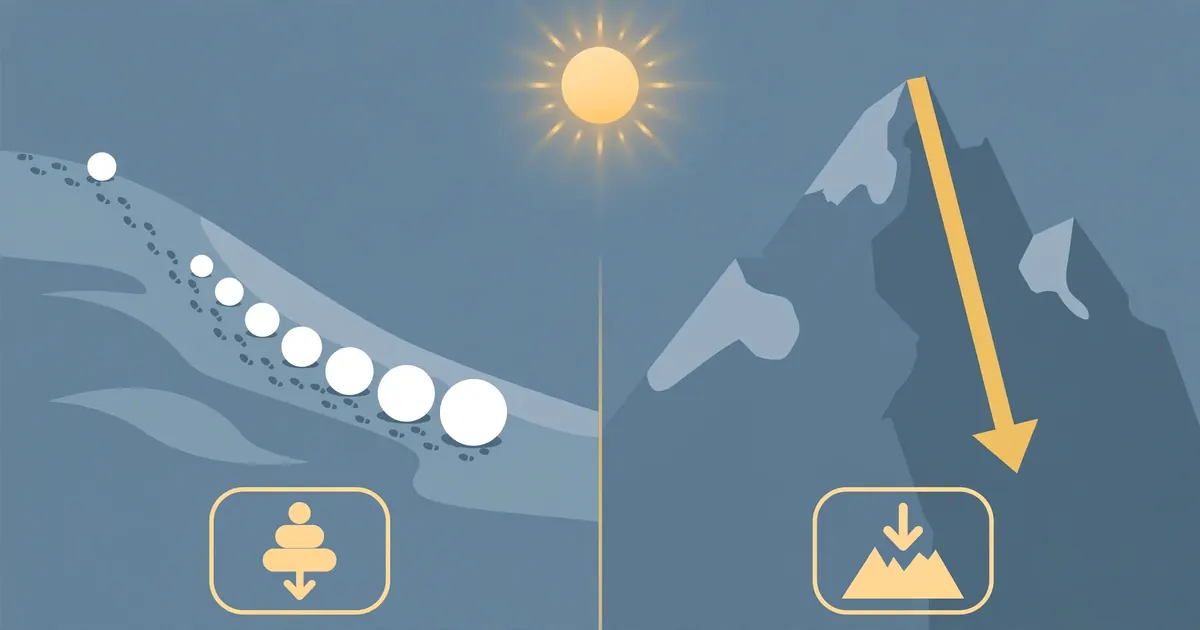
- If you have several cards, choose a payoff order. Comparing the snowball and avalanche methods can help you pick a sequence and stick with it.
- If minimums are all you can afford, that's information. It may mean the budget needs restructuring, or it may mean it's time to look at structured options like nonprofit credit counseling — where a counselor reviews your full financial picture for free. The point is to treat "I can only pay the minimum" as a signal to investigate, not a permanent state.
The minimum payment is not your enemy. It protects your account from late fees and your credit report from missed payments. But as a strategy for getting out of debt, the arithmetic is brutal: 18.5 years and $7,780 in interest on a $5,000 balance. Now that you've seen the numbers, you get to decide whether the minimum is really the plan — or just the starting point.
DebtRelief.site publishes general educational information only — not financial, legal, or tax advice. Consider speaking with a qualified professional about your situation.